
Rabby Wallet Extension: how transaction simulation and smart scanning change the DeFi security calculus
Most browser wallets ask a single, uncomfortable favor: “Trust me, sign this.” Rabby breaks that pattern. Rather than relying on user vigilance alone, Rabby inserts mechanistic checks—transaction simulation, pre-signing risk scans, and approval revocation—between a dApp’s request and the private key operation. For DeFi power users who move funds across chains and interact with complex smart contracts, those checks can be the difference between a recoverable operational mistake and a complete loss.
This article explains how Rabby’s extension works under the hood, what precise security and usability trade-offs it introduces relative to incumbents such as MetaMask or Trust Wallet, and what limits still matter for institutional or high-net-worth users in the US. I focus on mechanisms you can test and heuristics you can use when deciding whether to make Rabby your primary DeFi interface.
Mechanisms: transaction simulation, pre-signing risk scans, and automatic switching
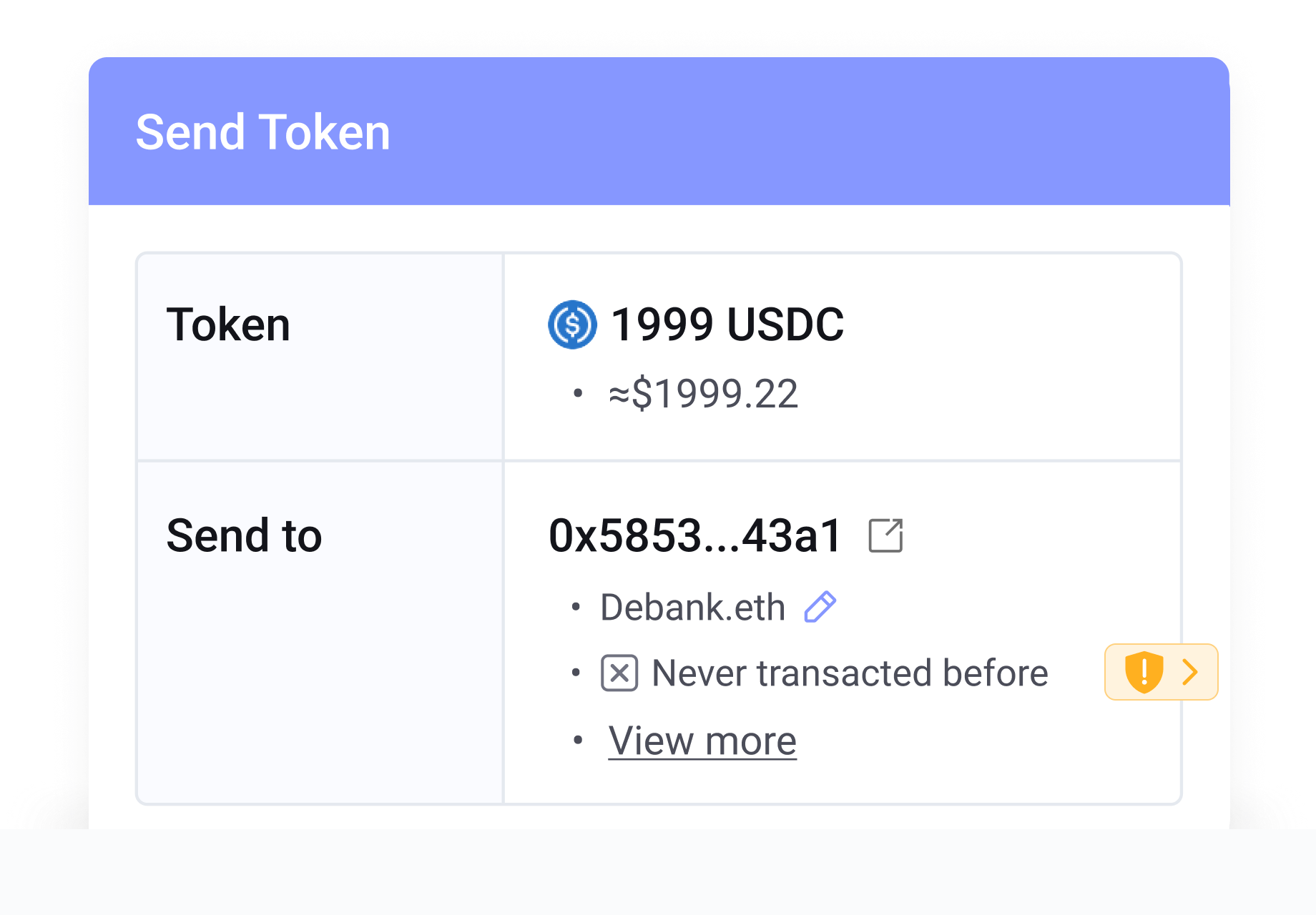
At its core Rabby extends the standard JSON-RPC flow between dApps and wallets by adding local, pre-signature analysis. When a dApp requests a signature, Rabby first simulates the transaction against a node or local EVM emulator to compute the expected state changes: token balance deltas, allowance updates, and gas estimates. That simulation yields a concrete, numerical preview a user can inspect instead of the vague method name that many wallets show.
Parallel to the simulation, Rabby runs risk heuristics: it checks whether the target contract has a history of exploits, whether the approval would grant unlimited spending rights, and whether the destination address appears non-existent or newly created in suspicious patterns. These checks produce categorical warnings rather than binary blocks—useful but not infallible. Because the wallet uses signature-level interception, it can reject or modify the signing flow and offer an approval revocation UI that lists active allowances and lets you cancel them without contacting the contract owner.
Operationally, Rabby also performs automatic network switching. When you open a dApp on, say, Arbitrum, the extension will detect chain-specific endpoints and prompt or switch to the appropriate network so the transaction simulation and gas estimation align with the target chain. Combined with a cross-chain gas top-up feature, this reduces the common user error of attempting a transaction on the wrong chain without gas funds.
Why the mechanisms matter for DeFi power users
Three concrete benefits follow from the above mechanics. First, the simulation converts uncertainty into inspectable numbers: will my token balance decrease by X, will token Y be swapped for token Z, what is the precise fee? Second, the pre-signing risk engine shifts some security decisions from gut judgment to reproducible signals—contract age, prior exploit flags, suspicious allowance requests—reducing room for social-engineered approval errors. Third, approval revocation and hardware-wallet compatibility let users apply least-privilege control patterns (grant narrow approvals, revoke them after use) without writing custom scripts.
For active DeFi traders and liquidity providers in the US, these translate into lower operational friction when interacting with multiple L2s and sidechains and a clearer path to integrate hardware wallets and institutional multi-sig solutions like Gnosis Safe. Rabby’s open-source MIT license also matters: a public codebase makes the simulation and scanning logic auditable by security researchers, which is a practical mitigation against hidden, wallet-level vulnerabilities.
Trade-offs and limitations you must accept
No tool is a silver bullet. Rabby’s simulation and scanning require accurate node state and timely threat intelligence. If the node used for simulation lags the canonical chain or the threat database is incomplete, simulations can produce false negatives or false positives. That is a limitation of supply: simulation accuracy depends on infrastructure and threat telemetry quality.
Rabby also does not solve the fiat on-ramp problem: there is no native, built-in way to buy crypto with USD inside the wallet, so US users still need to move funds through exchanges or custodial rails. The wallet likewise lacks native staking interfaces; staking must be done through external dApps, meaning users still need to vet those dApps separately. Finally, past incident history matters: Rabby’s swap contract was exploited in 2022 for roughly $190,000. The team froze the contract and compensated users, but the episode underscores that wallet ecosystems—extensions plus ancillary contracts—carry composite risk.
Comparative framing: where Rabby outperforms and where it doesn’t
Compared to MetaMask or Trust Wallet, Rabby’s strength is procedural: explicit pre-signature simulations and native approval controls. MetaMask shows method names and parameters; Rabby shows concrete balance changes and a risk summary. That difference is especially valuable when interacting with complex DeFi primitives—batch transactions, permit flows, or approval-heavy DEX interactions—because blind signing is a common source of loss.
However, if your primary requirement is fiat on-ramps, custodial convenience, or bundled staking flows, other wallets or exchange apps remain more direct. Rabby’s sweet spot is the technically engaged user who values granular control, hardware wallet integration, and institutional compatibility over a single-click fiat purchase.
Decision heuristic: when to use Rabby as your primary wallet
Use Rabby when you meet most of these conditions: you regularly interact with multiple EVM chains; you execute complex contract interactions (e.g., DeFi routers, multi-step swaps, liquidity migrations); you prefer to pair a hardware wallet with fine-grained allowance control; and you want an auditable, open-source wallet whose logic you can reason about. If you depend on fiat rails inside the wallet or need one-click staking dashboards, Rabby should be one component of a larger toolset rather than the singular interface.
A practical rule of thumb: if a single bad approval or blind-signed transaction would inflict materially more damage than a slightly slower UX, favor Rabby. The wallet deliberately trades marginal convenience for bigger, inspectable safety signals.
What to watch next (signals that matter)
Three signals will indicate whether Rabby’s approach is gaining structural advantage. First, broader adoption of pre-signature simulation by other wallets would validate the approach and improve ecosystem standards. Second, the quality and freshness of threat telemetry—how quickly new exploit patterns are flagged—will determine simulation utility; stagnating intelligence weakens the core promise. Third, institutional integrations (e.g., deeper multi-sig workflows or custody partnerships) would signal readiness for higher-value flows and compliance-conscious US entities.
None of these are guaranteed. If Rabby’s simulation infra lags or if threat feeds remain spotty, the apparent safety gains could be brittle. Conversely, tighter partnerships with custody providers and richer telemetry would compound value for institutional users.
For readers who want to test the mechanics directly, start with a non-custodial experiment: install the browser extension, import a read-only wallet (or use a hardware wallet on a small balance), and deliberately initiate a harmless allowance approval on a testnet dApp. Observe the simulation output and the revocation flow. If the numbers and warnings align with your expectations, you’ve gained a working mental model of what Rabby adds to the signing pipeline.
For a direct download link and installation guidance, consider the official entry point for the browser extension: rabby wallet.
FAQ
How does Rabby’s transaction simulation differ from a human reading the transaction data?
Simulation produces numerical state deltas by executing the transaction against a node or emulator, so you see expected token balance changes and gas usage. A human reading raw calldata often needs to decode ABI and infer effects; simulation gives concrete outputs rather than symbolic descriptions. The trade-off: simulation accuracy depends on node state and the chain data used for the run.
Can Rabby prevent all smart contract exploits and scams?
No. Rabby reduces exposure by flagging risky patterns, simulating effects, and enabling revocation. But it cannot retroactively stop an exploit that occurs off-chain, exploit a zero-day in an audited contract, or replace due diligence on novel protocols. Consider Rabby part of layered defense, not a single point of invulnerability.
Is Rabby suitable for institutional custody or multi-sig workflows?
Rabby integrates with multi-sig and enterprise solutions like Gnosis Safe and custody providers, and supports hardware wallets, making it viable as a front-end for institutional flows. Still, institutions should validate compliance, EDR/forensics requirements, and governance workflows before adopting any wallet into production.
What are the practical limits of Rabby’s approval revocation?
Revocation cancels allowances that exist on-chain, but it doesn’t retroactively undo a transfer already executed. Also, revocation itself is an on-chain transaction and costs gas; large portfolios on many chains will require recurring maintenance. The revocation tool reduces exposure but requires active management.